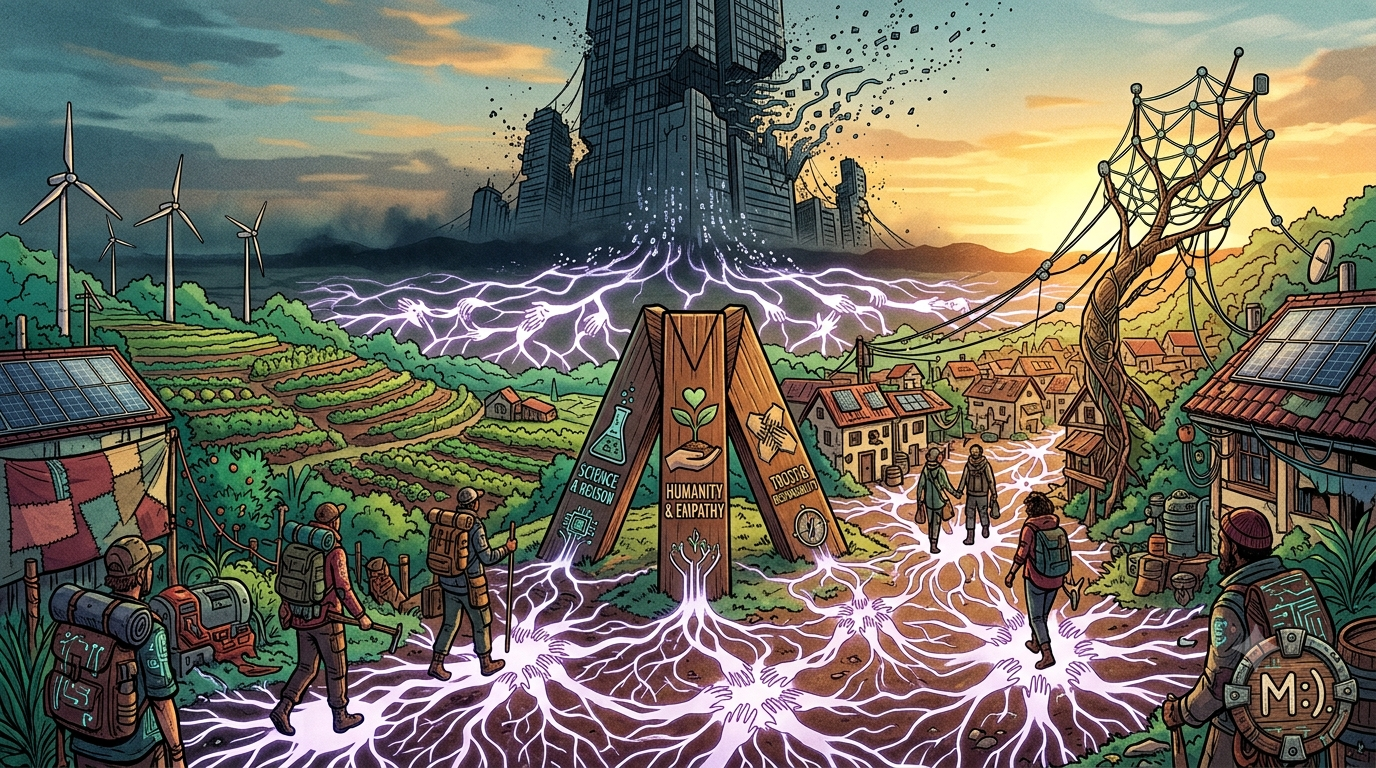
The #3pod and the Regenerative Region: Why Strong Subsidiarity Is Europe’s Last Humanist Gambit
Mars can wait. The hardest engineering problem is not interplanetary escape — it is designing a civilization that refuses to collapse into either centralized machine-slavery or fragmented ego clan wars. The answer is neither Left nor Right, neither East nor West. It is below and between: the region.
The Question That Should Keep Us Awake
Why is the most expensive infrastructure in human history given away for free?
Trillions of dollars are being burned to train and run centralized AI models, and the average citizen pays nothing. Every adult in the room knows there is no such thing as a free lunch. When you don’t pay with money, you pay with something else — and in this case, you are paying with the only assets you will ever truly own: your attention, your discernment, your relationships, and your ability to think independently.
The business model of the current AI land-grab is simple to state and terrifying to comprehend:
- Degrade the capacity to distinguish truth from noise by flooding human cognition with synthetic content — an AI column built from balast, deepfakes, and infinite engagement-optimized sludge.
- Cultivate dependency — replace communication with real people, in real places, with a machine that flatters your ego on demand and never demands the hard work of relationship.
- Control the population’s collective thinking at a level no propaganda ministry in history could dream of — not by censoring, but by curating the firehose.
- Monetize the captured population as a guaranteed utility — intelligence-as-subscription, billed monthly, state-blessed, like water, gas, and sewage.
- Own the resources — your data, your labor, your attention, and ultimately your future, extracted to cover the trillion-dollar bets placed on your continued captivity.
Profit privatized. Losses socialized. Ecosystem damage irreversible. This is not a conspiracy theory; it is a business plan, published openly in every investor deck. The only conspiracy is our silence.
So the question that keeps me awake is not “how do we stop them?” You cannot stop a spiderweb by attacking its threads. The question is: “What do we build instead — and how do we build it so it cannot be captured?”
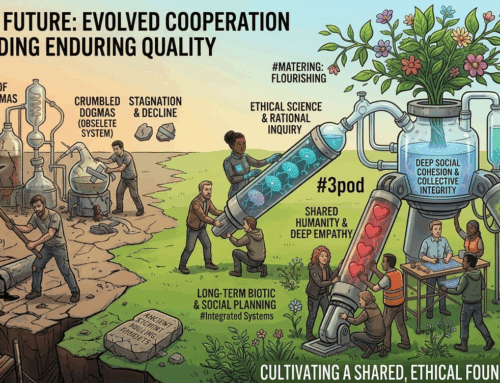
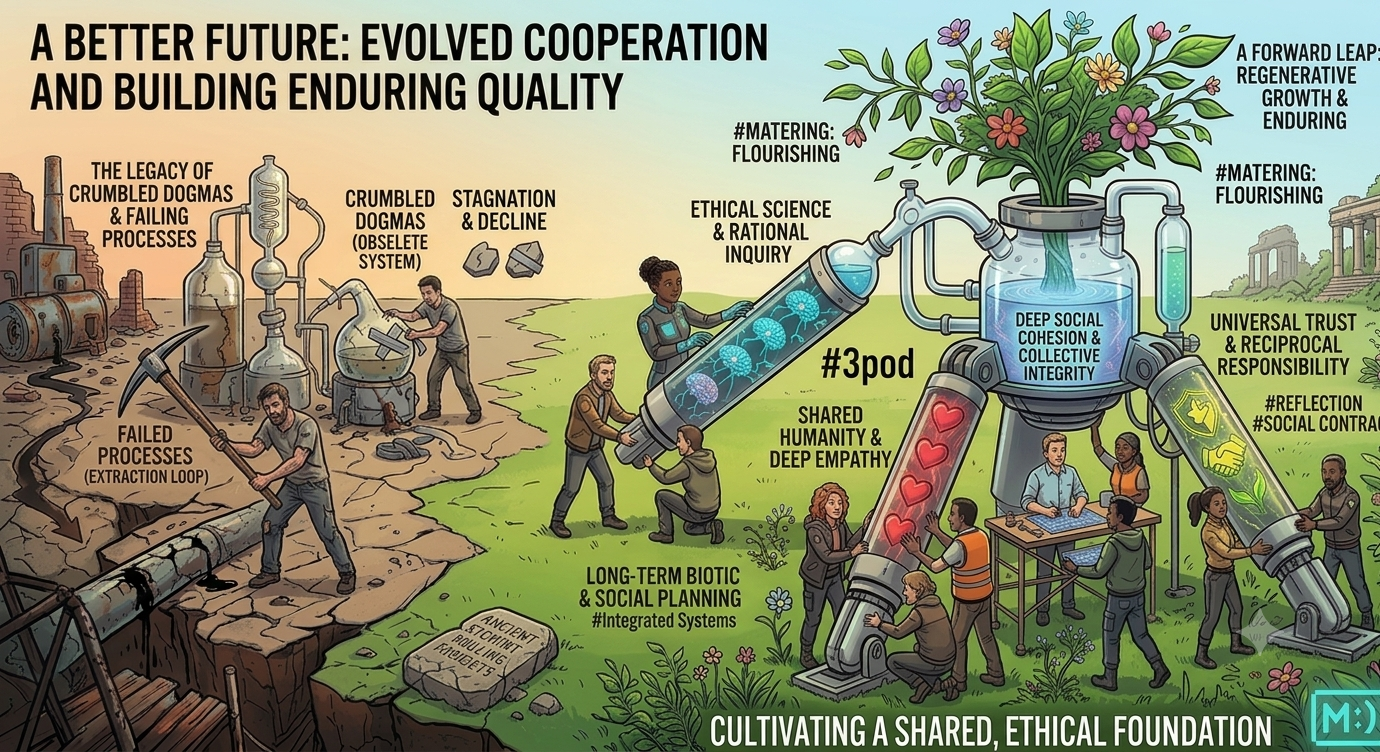
My answer, developed here as a continuation of the mycelial shift I described in July, has a name: the #3pod — and a political architecture: strong subsidiarity within a European humanist federation.
Recap: Why 1 & 1 & 1 > 3
In my previous essay, I argued that we do not suffer from a lack of technological capability. We suffer from a crisis of meaning. The equation 1&1&1 > 3 is not arithmetic — it is about emergence. Three core dualities, held together, produce a quality none of them possess alone:
- Science & Reason — the architecture. Rigorous, systems-level thinking that engineers local resilience without illusion: sovereign decentralized technology, autonomous multi-source energy grids, open-source communication nodes.
- Humanity & Empathy — the meaning. The grounding that ensures our scientific capacity serves life rather than extracting from it. The shift from earning to #mattering — being intrinsically connected to our communities, our ecosystems, and our shared reality.
- Trust & Responsibility — the grounding wire. Trust as the highest-bandwidth communication protocol we have; responsibility as the daily, radical act of owning your impact — executed not by top-down coercion, but by small, cooperative teams stewarding their own infrastructure and landscapes.
Separated, each leg is vulnerable: empathy without reason is paralyzed by the scale of global crises; science without responsibility builds weapons and walled gardens; trust without reason devolves into blind ideology. Merged, they form a mycelial web that distributes power, wisdom, and care to every node.
But a tripod with only philosophical legs still tips over. It needs a place to stand. It needs territory, economy, and governance. That is what this essay adds.
The Missing Fourth Dimension: Where the #3pod Stands
A tripod stands on ground. The three legs of Science, Empathy, and Trust must bear weight on something real. I propose that the ground is the regenerative region — and the load-bearing principle connecting them is strong subsidiarity.
Let me define terms precisely, because this is where most well-meaning movements dissolve into vagueness.
Subsidiarity, properly understood, is not decentralization-as-buzzword. It is a precise allocation rule: decisions must be made at the lowest possible level that is still competent to make them — and the higher level exists only to serve, never to absorb. Weak subsidiarity (the version practiced in most modern states) treats local entities as administrative delivery channels for centrally decided policy. Strong subsidiarity inverts the burden of proof: the region does not need to justify why it should decide; the center must justify why it must take over.
Under strong subsidiarity, the default is local sovereignty over everything a community can genuinely govern: its food, its water, its energy, its data, its children’s education, its local currency, its care for elders. The federal level retains only what physics and geography genuinely demand of scale: defense coordination, cross-border ecological integrity, interoperability standards, and the guarantee of fundamental rights.
This is not nationalism wearing a green coat. It is the opposite. It is the recognition that a European humanist federation is only worth having if it protects the small, the local, and the human against the large, the abstract, and the extractive — whether the extractor is a foreign hyperscaler or our own central bureaucracy.
Why Regions, Why Now: The Physics of Resilience
Here I must be blunt about the economics, because sentiment alone will not rebuild a civilization.
The extraction map is already drawn
European mid-sized firms — the backbone of our prosperity — are being offered a deal that is devilishly rational on paper: hand your processes, your data, and your know-how to AI agents hosted in US or Chinese data centers, pay per token, and receive a productivity boost. What the invoice doesn’t show is the second transaction: your competitive knowledge becomes training material for systems that will be sold to your competitors, cheaper. Your know-how becomes their leverage. Your region becomes a consumption node in someone else’s growth curve.
Multiply this across agriculture, manufacturing, healthcare, and administration, and you get the trajectory we already see: hollowed-out middle enterprises, sovereignty leaking byte by byte, and the EU AI Act — well-intentioned but compliance-heavy — functioning as a moat that only the giants can afford to cross. Small and medium enterprises constitute 99% of European businesses, and they lack the resources to comply with what was, ironically, written to protect them.
The energy bill is a planetary mortgage
AI-focused data centers are on track to consume on the order of tens of gigawatts — a meaningful fraction of national electricity demand — with projections putting AI’s carbon footprint for 2025 on par with an entire metropolis, and water footprints approaching global bottled-water consumption. Utilities are extending the lives of coal plants and building new gas turbines to feed this demand, while residents’ electricity bills rise. This is the socialized cost side of the “free” AI ledger: you pay the power surcharge; you inherit the stranded fossil assets; you drink the thinner aquifer.
Therefore: the region is the correct scale of resistance
Not the individual — who cannot negotiate with a trillion-dollar compute moat. Not the globe — where treaties die in committee. The region is where physics still allows a human community to be self-sufficient in the essentials: calories, kilowatt-hours, clean water, shelter, care, and — critically — meaning.
A region that generates its own multi-source energy (solar, wind, biogas, storage, microgrids), grows a meaningful share of its own food regeneratively, runs its own communication infrastructure (community mesh networks, open-source local nodes, federated services), keeps its money circulating locally (community-supported enterprise, complementary currencies, time banks), and controls its own data (sovereign, encrypted, locally hosted) is a region that cannot be starved by an embargo, monetized by an algorithm, or governed by a distant algorithmic utility.
That is not utopianism. Every component already exists at pilot scale in Europe. What is missing is the connective philosophy and the political container. The #3pod provides the philosophy; the European humanist federation must provide the container.
The European Humanist Federation: A Different Kind of Union
I want to be careful here, because this idea can be caricatured. So let me state what it is not.
It is not the Europe of commission circulars and compliance forms. It is not federalism as centralization with better branding. And it is emphatically not a withdrawal into tribe, flag, or blood-and-soil romanticism — that road leads back to the ego clan wars, which the mycelial shift exists to transcend.
The European humanist federation I advocate rests on three commitments, mirroring the three legs of the #3pod:
1. A federation of human beings and their communities, not of monopolies. Where the current union increasingly regulates citizens tightly while accommodating platform-giants loosely, a humanist federation reverses the polarity: strict boundaries on any entity (public or private) that accumulates decisive power over human cognition, communication, or essential resources — and expansive freedom for persons, families, cooperatives, and small enterprises. Data protection, yes; but beyond protection, data sovereignty: the legal presumption that the knowledge generated in a region belongs, first, to the people and enterprises who generated it.
2. Rights and duties of regions, codified. Regions gain enforceable rights: the right to operate public digital infrastructure under open standards, the right to prefer local procurement, the right to establish complementary currencies within transparency limits, the right to disconnect from specific transnational services for essential functions, and the right of initiative toward the center. In exchange, they carry duties: universal access to services, ecological regeneration targets measured in soil, water, and biodiversity — not in GDP — and the guarantee of fundamental rights to every person within their territory, regardless of origin. Humanism means these duties bind; a region that violates them forfeits its enhanced autonomy.
3. Economy in service of #mattering, not extraction. The federation’s economic goal is not the maximization of abstract capital value but the maximization of real, local, regenerative value loops — the shift from earning to mattering. This changes procurement, competition law, taxation, and research funding priorities. We are 450 million people with world-class science, deep craft traditions, and intact (if battered) social fabric. If we cannot build utility-grade open AI stacks, sovereign cloud infrastructure, and regenerative regional economies together, we have surrendered our children’s future to boardrooms in another hemisphere — or worse, to the fever dreams of men who measure legacy in launch cadence and Mars headcount while their rockets’ exhaust metastasizes our climate targets.
Mars can wait. The most ambitious engineering project in the universe is right here: proving that a technologically advanced species can survive its own adolescence by choosing radical responsibility over escapism.
A Regional Blueprint: The #3pod in Practice
Let me make this concrete. Here is what a committed region — a city of fifty thousand with its rural hinterland, or an intentional network of villages — can begin building within three years, using existing tools and the 1&1&1>3 logic at each step:
Phase One — The Audit and the Refusal (months 0–12) Map the region’s extraction dependencies: which digital services, which energy imports, which food supply chains, which data flows leave the region and never return. Simultaneously, run the great detox: migrate the municipality, schools, and willing businesses to open-source, encrypted, European-hosted tools; teach cognitive self-defense — how manipulation architectures work, why “free” AI is paid in your discernment — as seriously as we once taught traffic safety. This is the Trust leg: without shared understanding, nothing else holds.
Phase Two — The Sovereign Stack (years 1–3) Deploy the physical and digital commons: community mesh and fiber networks with federated communication services; a multi-source energy microgrid with municipal storage; regenerative agriculture cooperatives consolidating food logistics; local data vaults under cooperative ownership with independent, published audits of everything that leaves the region. This is the Science & Reason leg engineered downward: not a grand national program, but a hundred competent, coordinated local ones.
Phase Three — The Regenerative Loop (years 2–5 onward) Close the loops: procurement redirected to regional enterprises that feed back into local wages; complementary instruments (time banks, community vouchers) keeping value circulating instead of evaporating into quarterly reports elsewhere; care systems — eldercare, childcare, apprenticeship — organized as community institutions rather than extracted services; and a regionally owned competence center where local know-how is developed and held locally, not uploaded to someone else’s training run. This is the Humanity & Empathy leg: an economy whose success metric is whether children raised in the region want to stay, build, and matter there.
The emergent property: no single phase would survive alone. The mesh without the energy grid is fragile; the energy grid without the detox leaks; the whole stack without the local economy becomes a museum piece. Together they reproduce, at regional scale, the 1&1&1>3 emergence — a self-strengthening mycelial node. And when many such regions federate, sharing standards and solidarity without surrendering their ground truth, you have something no hyperscaler can replicate and no autocrat can decapitate: a federation whose strength comes from the autonomy of its parts.
The Honest Objections
I owe you the counterarguments, because conviction without stress-testing is just another clan banner.
“This is naively local. Global problems need global solutions.” Partly true — climate, pandemics, and existential risk demand continental coordination. That is precisely why this is a federal vision, not a separatist one. Strong subsidiarity does not abolish the higher level; it disciplines it, confining it to what genuinely requires scale while starving the pathological centralization that currently eats both our democracies and our ecosystems.
“Small regions cannot compete with hyperscale AI.” At raw model scale, no. But most of what regions need is not frontier-model intelligence; it is dependable, auditable, privacy-preserving processing of local information — logistics, care scheduling, energy balancing, small-enterprise bookkeeping. That runs fine on lean open models on regional hardware. We do not need to win their game. We need to make their game irrelevant to our survival. You do not defeat a monopoly by out-scaling it; you defeat it by out-growing your need for it.
“Won’t strong regions fragment Europe?” Fragmentation happens when regions feel absorbed and react with defensive tribalism. The antidote to clan wars is not stronger central grip — history is unambiguous on this point: imposed unity breeds resentment, and the resentments eventually find a strongman. The antidote is legitimate, dignified, flourishing local agency within a shared humanist frame. Mycelia do not compete; they interconnect.
The Call: Become a Node
I have watched two large centralized systems be built in this country with genuine idealism, and I have watched how their data copies and control drifted into the hands of a small circle of oligarchs — in a nation of ten million. Scale that lesson to four hundred and fifty million and to infrastructure run by actors beyond any European court’s reach, and the conclusion is not pessimism. It is clarity.
The techno-feudal spiderweb will not be voted down, regulated into humility, or reasoned with. It will be outgrown — by a foundation so deeply rooted, sovereign, and human that its extraction games find nothing left to extract.
So here is my invitation, in plain terms:
- Start where you stand. One municipality, one valley, one district. Map your extraction. Run your detox. Plant your first mesh node, your first cooperative, your first community energy project.
- Connect sideways, not upward. Find the other regions doing this work. Exchange blueprints, software, seeds, and people. Federation is built from the bottom by networks that choose each other, not granted from the top.
- Hold the tripod. Refuse all three reductions: reason without heart, empathy without rigor, trust without accountability. When someone offers you a movement with only one leg, decline politely and keep building.
- And refuse the escape hatch. Every euro and every electron pointed at cosmic lifeboats for a chosen few is diverted from soil, water, schools, and neighbors here. We fix this planet or we fix nothing.
The spiderweb is efficient. The mycelium is alive. Efficient things die with their central node. Living things regenerate from every point where two strands touch.
Touch someone. Start a strand.
#3pod #MycelialShift #StrongSubsidiarity #RegenerativeRegions #EuropeanHumanistFederation #MatteringOverEarning #OAI #Decentralize #EarthFirst
If this resonates, share it with your neighbors — the physical ones. Then pick one concrete project and start this season. The region you save may be your own. Let’s cultivate #reKraj regenerative resilient regions together!